CVI : Cortical visual impairment

What are cortical visual impairment ?

Neurovisual disorders (NVD) are a "poor ability" (or inability) of the nervous system to transmit and/or manage information perceived by the eyes.

They impact vision as well as cognitive development.
Even with perfectly healthy eyes, vision can be affected.
Neurovisual disorders impact the daily lives of those who suffer from them.
The consequences are felt at both the physical and psychological levels.
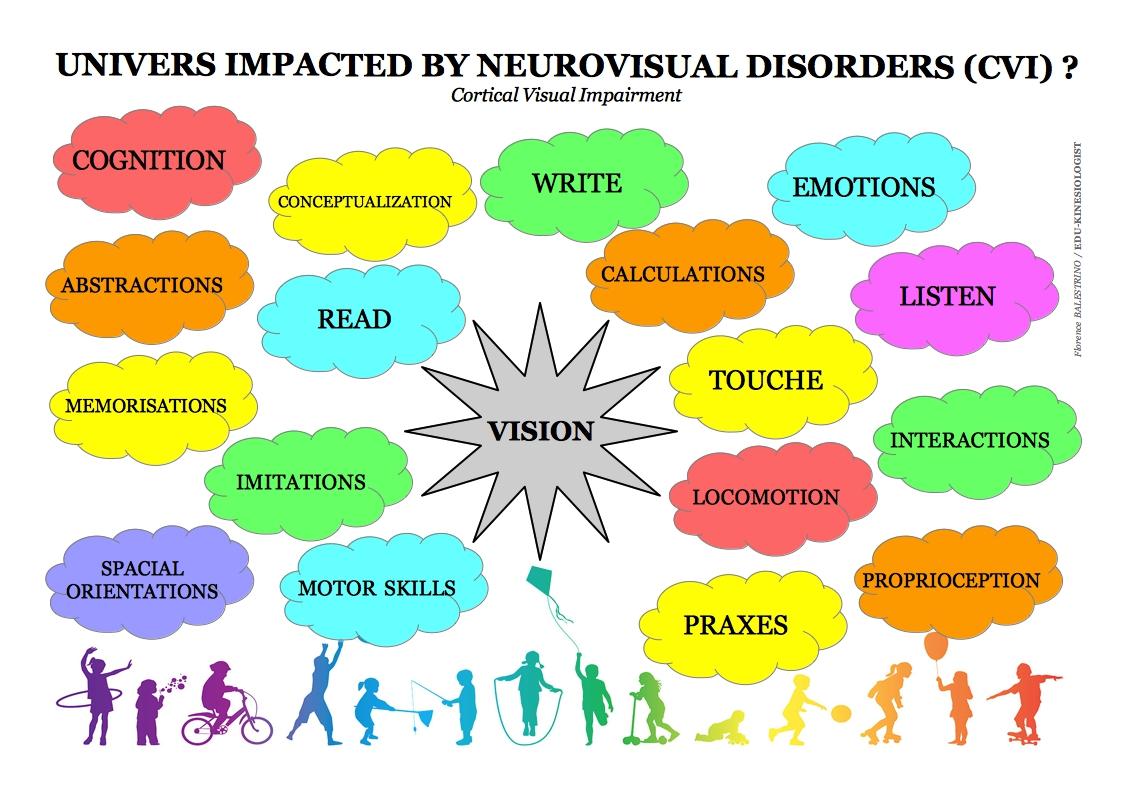
Univers impacted by neurovisual disorders cvi

Epidemiological data indicate a steady increase in NDD (neurodevelopmental disorders)

  • ADHD: 5% of children and adolescents / 2.5% of adults
  • Dyslexia: 5 to 17% of school-aged children
  • Dyspraxia: up to 6% of the population
  • Intellectual disability: 1% of the general population
  • ASD/Autism: 0.9 to 1.2% of births

CORTICAL VISUAL IMPAIRMENT : 6 to 13% of all children!!!
IT IS AN INVISIBLE VISION DISABILITY

You must be more vigilant if your child has had difficult birth conditions, trauma, or an infectious disease.

  • Prematurity
  • Respiratory distress
  • Faulty growth
  • Infectious disease
  • Gestational diabetes
  • Head trauma
  • Antenatal or perinatal distress
  • Neonatal stroke
  • Cardiac pathology

But it has been found that children without risk factors can also suffer from Neurovisual Disorders !

  • Who better than parents to be the observers of their children?
  • If you think there are abnormal elements in your child's behavior...
  • If you find it difficult to interact with them.
  • Or if they tend to adopt atypical or unbalanced positions when reading or writing.

If your baby's or child's development seems abnormal, if you observe:

  • Difficulties with movements, frequent clumsiness
  • Little or no interest in visual communication
  • Autistic-type difficulties
  • Dys-type disorders
  • ADD (Attention Deficit Disorder), with or without hyperactivity
  • Persistent learning difficulties

Consider that you should definitely consult for Neurovisual Disorders!

CVI* are also observed in people with other health disorders or events:

  • Dyspraxia, Dyscalculia, Dysorthography, etc.
  • ADHD (With or without Hyperactivity)
  • ASD (Autism Spectrum Disorders)
  • Stroke (Adult or Child)

(Cortical Visual Impairment / Neurovisual Disorder)

The scientific work of Sylvie Chokron (A French neuropsychologist and first-class research director at the CNRS) has led to numerous advances in the recognition and treatment of NVD.

Here's a podcast about it.

  • Welcome to "Quoi de Neuf Santé," an RTL podcast in partnership with the PRO BTP Health Observatory. When the brain prevents you from seeing!
    • A child with severe learning disabilities may suffer from neurovisual disorders, or CVI.
    • CVI affects visual function of cerebral origin, impacting the visual field, gaze control, visual memory, and many other aspects.
    • Their detrimental impact on children's learning abilities means that this visual impairment is too often confused with an intellectual disability, a learning disability, or an autistic disorder.
  • Click here to listen to the podcast

https://www.rtl.fr/programmes/quoi-de-neuf-sante/7900446609-comment-voir-ce-que-l-enfant-ne-voit-pas-avec-le-docteur-sylvie-chokron

NEUROVISUAL DISORDERS and CORTICAL BLINDNESS / CORTICAL VISUAL IMPAIRMENT (CVI) ?

AUTISM AND CVI

BRAIN INJURIES: WHAT IMPACT ON VISION?

PSYCHIC DEVELOPMENT & CONSTRUCTION


Florence Balestrino is an Edu-Kinesiologist / Trainer

  • She is a healthcare professional trained in the screening and rehabilitation of neurovisual disorders
    • Level 1: Recognizing, Screening, and Evaluating Neurovisual Disorders in Children - Understanding the Rehabilitation Principles for These Different Disorders (Pédagoji-Sylvie Chokron)
    • Level 2: Rehabilitation of Neurovisual Disorders According to Their Specificities (Pédagoji-Céline Perez-Guillaumet & Sophie Allard)

*The World Health Organization (WHO) defines health as "a state of complete physical, mental, and social well-being, (which) does not consist merely in the absence of disease or infirmity." Health is thus considered holistically. It is associated with the notion of well-being.

  • She doesn't belong to the medical profession, does not provide diagnoses, and does not prepare reports for medical purposes.
  • A letter explaining possible educational adjustments may be sent to you as needed.